

US Economic Growth Revised : GlobalFinMate
The U.S. economy grew at a rate of 0.7% in the fourth quarter of 2025, according to a second estimate released on Friday by the Bureau of Economic Analysis (BEA). This downward revision from an earlier estimate of 1.2% has sent ripples through financial markets and sparked renewed debate among economists regarding the true health and trajectory of the nation’s economic landscape. At GlobalFinMate, we delve into the nuances of these figures to provide you with comprehensive insights into what this means for your financial future.
Understanding the Revision: More Than Just a Number
The initial estimate for Q4 2025 GDP growth had painted a slightly more optimistic picture. However, the BEA’s second estimate, which incorporates more complete data, often offers a more accurate reflection of economic activity. The revision to 0.7% is significant because it indicates a sharper deceleration than previously thought, especially when juxtaposed against the robust growth seen in earlier quarters of 2025. While positive growth is always preferable to contraction, a figure below 1% suggests a considerable loss of momentum as the year drew to a close.
This deceleration can be attributed to several factors. Analysts at GlobalFinMate point to a potential cooling in consumer spending, which typically accounts for a significant portion of GDP. Supply chain challenges, though easing in some sectors, may still have exerted pressure, alongside higher interest rates designed to curb inflation. Businesses, perhaps anticipating a slowdown, might have also scaled back on investments, further contributing to the revised figures.
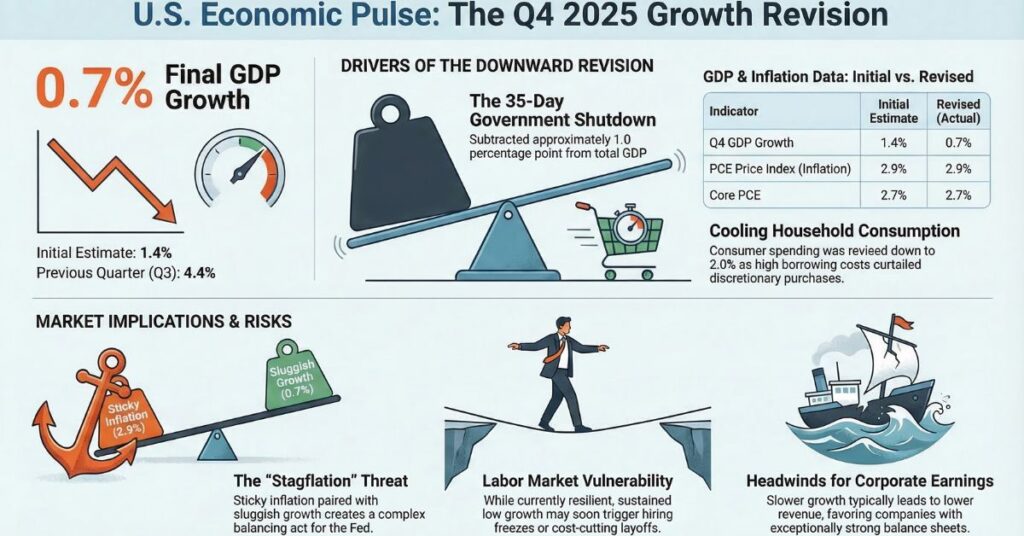
Key Drivers Behind the Slowdown
Digging deeper into the BEA report, several components contributed to this revised slowdown:
- Consumer Spending: While resilient for much of 2025, the revised data suggests a moderation in household consumption, particularly in durable goods and certain services. Inflationary pressures and the cumulative effect of higher borrowing costs likely made consumers more cautious with their discretionary spending.
- Business Investment: Nonresidential fixed investment, a critical indicator of business confidence and future growth potential, also saw a weaker performance than initially estimated. Uncertainty surrounding economic outlooks and geopolitical tensions may have prompted companies to postpone expansion plans.
- Government Spending: Federal, state, and local government spending components also played a role. Any adjustments in public sector expenditures can have a measurable impact on overall GDP.
- Net Exports: The trade balance, while sometimes volatile, can significantly influence GDP. A widening trade deficit (imports exceeding exports) can subtract from overall growth. Given the global economic environment and potential shifts in international demand, this component would have been closely scrutinized.
Implications for the U.S. Economy
A growth rate of 0.7% has multifaceted implications for various facets of the U.S. economy.
Inflation and Monetary Policy
One of the most immediate concerns is how this slower growth might impact the Federal Reserve’s monetary policy decisions. The Fed has been aggressively raising interest rates to combat persistent inflation. A significant slowdown in economic activity could provide some relief on the inflation front, potentially influencing the Fed’s stance on future rate hikes. However, if inflation remains stubbornly high despite weaker growth – a scenario known as stagflation – the central bank faces an even more challenging balancing act. For investors, globalfinmate emphasizes the importance of monitoring Fed communications closely for any shifts in their hawkish or dovish outlook.
Labor Market Dynamics
While the labor market has shown remarkable resilience, a sustained period of weak GDP growth could eventually spill over into employment figures. Companies might become more hesitant to hire, and some might even consider layoffs to cut costs. A healthy economy typically requires a robust job market, and any weakening here could dampen consumer confidence and spending further, creating a negative feedback loop.
Corporate Earnings and Stock Market
Corporate earnings are directly tied to economic activity. Slower growth generally translates to lower revenue and profit growth for businesses. This, in turn, can weigh on stock market performance. While individual sectors may perform differently, a broad-based economic slowdown typically presents headwinds for equity markets. Investors are likely to become more selective, favoring companies with strong balance sheets and resilient business models. Globalfinmate advises reviewing your portfolio strategy in light of these developments.
A Broader Economic Context: Q4 2025 in Perspective
To fully appreciate the significance of the 0.7% growth, it’s helpful to place it within a broader context. The U.S. economy experienced periods of stronger growth earlier in 2025, fueled by pent-up demand and government stimulus. The transition to a more moderate growth environment was anticipated by many, but the extent of the slowdown in Q4 might be more pronounced than expected.
Comparing Q4 2025 to pre-pandemic growth trends or even the average growth rate of the past decade reveals a stark contrast. While some moderation is natural after a period of rapid expansion, sustained growth below 1% raises questions about the underlying strength and sustainability of the recovery.
Expert Insights and Future Outlook
Economists are divided on what this revised Q4 data portends for 2026. Some believe it’s a necessary cooling period, a sign that the economy is finally adjusting to higher interest rates and moving towards a more sustainable, albeit slower, growth path. They argue that this slowdown could prevent the economy from overheating, thereby helping to bring inflation under control without triggering a deep recession.
Others express concern, suggesting that the U.S. economy might be teetering on the brink of a recession. They point to lagging indicators, such as corporate bankruptcies or significant increases in unemployment, as potential next steps if growth continues to stagnate. The global economic environment, marked by geopolitical tensions and varying growth trajectories in major economies like China and Europe, also adds layers of complexity. The image, referencing China-US trade, serves as a poignant reminder of the interconnectedness of global economies and how external factors can influence domestic performance.
For globalfinmate, our analysis indicates that businesses and consumers must prepare for a potentially challenging but not necessarily catastrophic 2026. Adaptability, prudent financial planning, and a keen eye on economic indicators will be crucial.
FAQs: US Economic Growth
What exactly was the revision to the Q4 2025 GDP?
The Bureau of Economic Analysis (BEA) lowered its estimate for U.S. economic growth in the fourth quarter of 2025 from an initial 1.4% down to 0.7%. This indicates the economy grew at half the rate originally reported, following a much stronger 4.4% growth rate in Q3 2025.
Why was the GDP growth rate revised downward?
The “Second Estimate” uses more complete data than the “Advance Estimate.” The major factors for this specific downgrade included:
1. Consumer Spending: Revised down to a 2.0% annual rate (from 2.4%), as households grew more cautious.
2. Government Spending: Significantly impacted by the 35-day government shutdown in late 2025, which subtracted roughly 1.0 percentage point from the total GDP.
3. Net Exports: Revised downward due to weaker demand for U.S. services and intellectual property.
Does a 0.7% growth rate mean the U.S. is in a recession?
No. A recession is typically defined by a sustained period of negative growth (contraction). A 0.7% rate is still growth, but it is considered a “soft” or “sluggish” performance. However, because it is below 1%, economists are concerned about a loss of momentum heading into 2026.
How did inflation perform during this period?
Interestingly, the revision showed that while growth slowed, inflation remained somewhat sticky. The PCE Price Index (the Fed’s preferred inflation gauge) held steady at 2.9%, while the “Core” PCE (excluding food and energy) remained at 2.7%. This persistent inflation despite slower growth has sparked fears of stagflation.
What does this mean for Federal Reserve interest rates?
The Federal Reserve faces a “balancing act”:
1. The Dovish View: If growth remains weak, the Fed may pause or cut interest rates to prevent a recession.
2. The Hawkish View: Since inflation (2.9%) is still above the 2% target, the Fed may be hesitant to lower rates too quickly, fearing inflation might rebound.
Conclusion: Navigating the Slowdown with GlobalFinMate
The revised U.S. economic growth rate of 0.7% for the fourth quarter of 2025 is a sober reminder that economic trajectories are rarely linear. It signals a significant deceleration as the year concluded, influenced by moderating consumer spending, weaker business investment, and the overarching impact of inflation and higher interest rates.
For individuals and businesses, this news underscores the importance of sound financial management and staying informed. At globalfinmate, we are committed to providing you with timely analysis and actionable insights to help you navigate these economic shifts. While a slowdown presents challenges, it also creates opportunities for those who are prepared and strategically positioned. Keep a close watch on upcoming economic data, central bank decisions, and global developments, as these will continue to shape the economic narrative in the months ahead. Your financial well-being in an evolving economic climate depends on informed decisions, and GlobalFinMate is here to guide you every step of the way.
About The Author
