
Great Career Fields for the Future (Next 10 Years)
Let’s be honest — choosing a career is one of the most important financial decisions you’ll ever make. It shapes how much money you earn, how stable your life feels, and whether you’re chasing opportunities or waiting for them to find you.
For a long time, people were told to “follow their passion.” And while that sounds inspiring, passion alone doesn’t pay the rent. If you’re working in a shrinking industry or a field with too many candidates and too few jobs, even the most motivated person can end up frustrated.
A smarter approach? Find work you can genuinely enjoy AND build a skill set around careers that the economy actually needs. When you land at that intersection, you stop worrying about job security and start thinking about growth.
So, which careers actually fit that description right now? The U.S. Bureau of Labor Statistics (BLS) publishes an Occupational Outlook Handbook that tracks job growth, median wages, and education requirements across hundreds of occupations. Using that data as a foundation, we’ve put together this guide to 20 career fields that show strong potential over the next decade.
What Makes a Career “Future-Proof”?
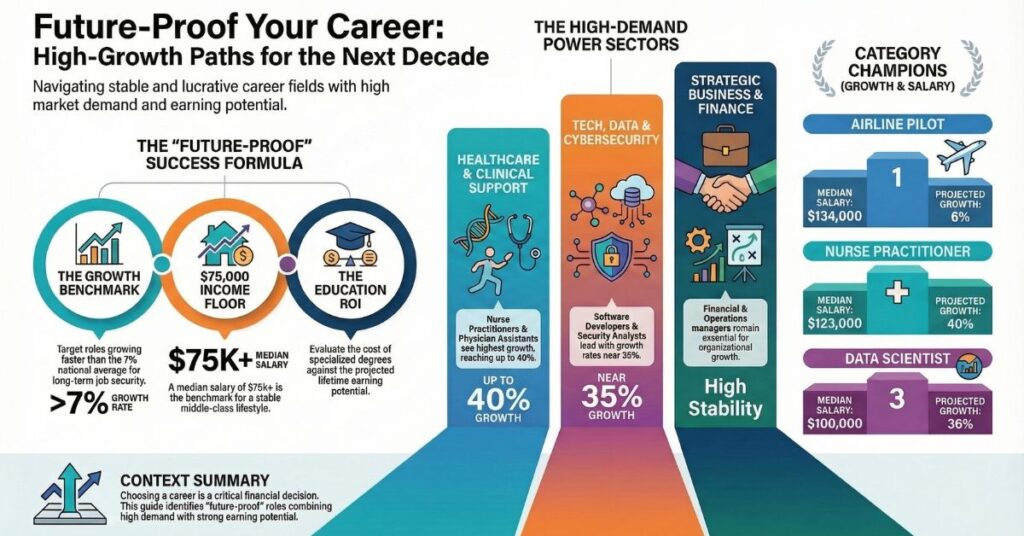
Before diving into the list, it helps to understand what we’re looking for. Three factors stand out when evaluating career longevity:
Job Growth Rate — Is the demand for this role increasing? A career growing faster than the national average (roughly 7%) signals that employers are actively hiring and that won’t slow down anytime soon.
Earning Potential — A good career should allow you to cover your everyday costs, save for the future, build an emergency fund, and eventually reach major financial goals like buying a home or retiring comfortably. As a rough benchmark, a median income of $75,000 or more tends to support a middle-class lifestyle in most U.S. states.
Education vs. Return — Some high-paying roles require years of advanced study. Others only need an associate’s degree or specialized training. Knowing what you’re investing before you commit is critical, especially with student loan debt being such a major burden for so many people today.
The careers on this list generally score well on all three dimensions.
20 Great Career Fields for the Future
1. Software Developer
Technology isn’t slowing down, and neither is the demand for people who build it. Software developers design, write, and maintain the programs that power everything from smartphone apps to corporate networks. They study user needs, write code to meet those needs, test their work, and keep updating systems as technology changes.
- Work Environment: Mostly office-based or remote. Full-time schedule, often in collaborative teams.
- Education: Bachelor’s degree in computer science or a related field. Staying current with new programming languages is essential throughout the career.
- Median Annual Salary: Around $109,000
- Projected Job Growth: Approximately 25% over the next decade — that translates to hundreds of thousands of new positions.
If you enjoy logical thinking and problem-solving, this is one of the most financially rewarding paths available.
2. Financial Manager
Every organization — whether it’s a startup, a hospital, a bank, or a government agency — needs someone to oversee its money. Financial managers track income and expenses, prepare financial reports, manage investments, and guide long-term financial planning.
This role sits at the intersection of strategy and numbers. It’s not just about bookkeeping; it’s about helping organizations make smarter decisions with their resources.
- Work Environment: Banks, insurance firms, investment companies, and corporations. Typically full-time with close collaboration with senior leadership.
- Education: Four-year degree in finance, economics, or business. Several years of experience in a related financial role is usually expected.
- Median Annual Salary: Around $131,000
- Projected Job Growth: Roughly 17%, adding over 120,000 new jobs
For those with a passion for finance, this is one of the most rewarding long-term career paths available.
3. Nurse Practitioner (NP)
Healthcare continues to be one of the most stable and in-demand industries in the world. A Nurse Practitioner goes well beyond the role of a standard registered nurse — NPs can diagnose conditions, prescribe medications, and manage patient care independently in many states.
The growing and aging population means that demand for NPs is not just steady, it’s accelerating.
- Work Environment: Hospitals, clinics, urgent care centers, schools, and private practices.
- Education: Must first become a licensed registered nurse, then complete a graduate-level NP program and earn national certification.
- Median Annual Salary: Around $123,000
- Projected Job Growth: Up to 40% over the next decade — one of the fastest-growing occupations in the entire country
If you’re drawn to helping people and can handle the educational commitment, this career offers exceptional job security and income.
4. Medical and Health Services Manager
Behind every well-run hospital or clinic, there’s a team of health services managers keeping everything organized. These professionals handle scheduling, billing, medical records, compliance, and coordination between departments — so that doctors and nurses can focus entirely on patients.
- Work Environment: Hospitals, group practices, nursing homes, and clinics.
- Education: A bachelor’s degree in healthcare administration is typically the minimum. Many employers prefer a master’s degree.
- Median Annual Salary: Around $101,000
- Projected Job Growth: Around 28%, adding more than 136,000 new positions
This is a great option for people who want to work in healthcare without being in a clinical role.
5. Information Security Analyst
As more of our personal, financial, and business activity moves online, the need to protect that data has become critical. Information security analysts build and maintain defenses against cyberattacks. They monitor systems, investigate breaches, install protective software, and develop recovery plans.
Given that data breaches cost businesses millions and can destroy customer trust overnight, companies aren’t cutting this role anytime soon.
- Work Environment: Finance, insurance, tech, and consulting companies. Demanding hours when security incidents occur.
- Education: Bachelor’s degree in computer science or a related field. Experience in database administration or IT systems is a strong advantage.
- Median Annual Salary: Around $102,000
- Projected Job Growth: Around 35% — among the highest of any tech occupation
If you’re interested in technology and also care about protecting people and systems, this is a compelling path.
6. Data Scientist
We live in a data-driven world. Companies collect enormous amounts of information every day — about customer behavior, sales trends, market shifts, and more. Data scientists are the people who turn that raw data into clear, actionable insights using math, programming, and statistical modeling.
- Work Environment: Any large organization across industries including finance, retail, healthcare, and government. Primarily desk-based with strong analytical tools.
- Education: A bachelor’s degree in math, statistics, computer science, or engineering is a starting point. Most data scientists hold a master’s degree or higher.
- Median Annual Salary: Around $100,000
- Projected Job Growth: About 36%, adding more than 40,000 new roles
This field suits people who are comfortable with numbers, enjoy uncovering patterns, and want a career at the center of business decision-making.
7. Physician Assistant (PA)
Similar to a Nurse Practitioner, a Physician Assistant works closely with doctors to deliver patient care. PAs can examine patients, order lab work, interpret results, diagnose illnesses, prescribe treatments, and in some rural areas, serve as a patient’s primary care provider.
- Work Environment: Doctors’ offices, hospitals, surgical centers, and clinics. Full-time schedule, sometimes including evenings or weekends.
- Education: A master’s degree from an accredited PA program is required, typically after completing a bachelor’s degree. Many PAs come from backgrounds as nurses, paramedics, or EMTs.
- Median Annual Salary: Around $121,000
- Projected Job Growth: Around 28%, with nearly 40,000 new jobs expected
This is a high-earning, high-impact healthcare career that requires less training time than becoming a physician.
8. Management Analyst (Consultant)
Businesses regularly bring in outside experts to identify inefficiencies, reduce waste, and find new ways to grow. Management analysts — often called management consultants — do exactly that. They study how a company operates, speak with staff at all levels, review financial data, and present recommendations to leadership.
- Work Environment: A mix of their own office and their clients’ locations. Travel is common, and deadlines can be intense.
- Education: A bachelor’s degree in business, social science, or engineering is the baseline. An MBA is preferred by many firms. Relevant industry experience adds significant value.
- Median Annual Salary: Around $93,000
- Projected Job Growth: About 11%, adding more than 100,000 jobs
If you like variety, problem-solving across industries, and strategic thinking, this career offers both challenge and solid compensation.
9. Physical Therapist
Physical therapists help people recover movement and manage pain following injuries, surgeries, or chronic conditions. Through targeted exercises, hands-on techniques, and patient education, they help people rebuild strength and regain independence.
- Work Environment: Clinics, hospitals, rehabilitation centers, nursing homes, and private homes.
- Education: A Doctor of Physical Therapy (DPT) degree is required. These programs typically take three years after completing an undergraduate degree.
- Median Annual Salary: Around $95,000
- Projected Job Growth: Around 17%, with more than 40,000 new positions expected
An aging population and growing awareness of physical rehabilitation ensure steady demand in this field for decades to come.
10. Logistician
When the global supply chain broke down during the pandemic, the world got a crash course in how essential logistics professionals really are. Logisticians manage the flow of goods from production to delivery — overseeing inventory, transportation, warehousing, and the many moving parts of a supply chain.
- Work Environment: Manufacturing companies, retail chains, government agencies, and logistics firms. Fast-paced and detail-oriented.
- Education: A four-year degree is standard, though some companies accept candidates with an associate’s degree and practical experience. Military service is also a recognized pathway.
- Median Annual Salary: Around $77,000
- Projected Job Growth: Around 28%, adding roughly 54,000 new jobs
As global trade continues to grow and companies prioritize supply chain resilience, this career offers strong stability.
11. Operations Research Analyst
These professionals use mathematical modeling and statistical analysis to help businesses solve complex operational challenges. Think of them as problem-solvers who work with numbers — helping companies decide how to allocate budgets, price products, schedule workers, or organize inventory more efficiently.
- Work Environment: Offices across a wide range of industries, often in teams alongside engineers and executives.
- Education: A bachelor’s degree in math, engineering, or business is a typical starting point. Many employers prefer a master’s degree for senior-level roles.
- Median Annual Salary: Around $82,000
- Projected Job Growth: About 23%, adding more than 24,000 new positions
If you enjoy applied mathematics and want a career that sits at the center of business strategy, this is worth exploring.
12. Web Developer
Every business today needs a digital presence, and behind every functional website is a web developer. These professionals are responsible for how a site looks, how fast it loads, how it handles traffic, and how users interact with it. The field includes front-end developers (user experience and design), back-end developers (the infrastructure), and full-stack developers (both).
- Work Environment: Offices, agencies, or remote. Nearly 1 in 5 web developers are self-employed.
- Education: Ranges from a high school diploma with specialized coding skills to a bachelor’s degree in computer science. Many developers build their skills through online bootcamps or self-directed learning.
- Median Annual Salary: Around $78,000
- Projected Job Growth: About 23%, with more than 45,000 new jobs expected
One of the more accessible tech careers, especially for people who prefer self-directed learning over formal degrees.
13. Medical Scientist
Every medical breakthrough — from vaccines to new cancer treatments — starts with research. Medical scientists conduct lab experiments and field studies to understand diseases, develop new drugs and therapies, and help design public health programs.
- Work Environment: Research hospitals, pharmaceutical companies, universities, and government health agencies.
- Education: Most medical scientists hold a PhD in biology or a life science. Some hold an MD instead.
- Median Annual Salary: Around $95,000
- Projected Job Growth: About 17%, adding more than 20,000 new jobs
This career is ideal for those who are deeply curious, patient with long research timelines, and motivated by making a difference at scale.
14. Speech-Language Pathologist
Speech-language pathologists work with patients who have difficulty speaking, communicating, or swallowing. They assess the root causes of these challenges and develop personalized treatment programs. Their patients range from young children with developmental delays to adults recovering from strokes.
- Work Environment: Schools account for nearly 40% of all positions in this field. The rest work in hospitals, nursing homes, private clinics, and therapy offices.
- Education: A master’s degree in speech-language pathology is the standard requirement. Licensure and clinical hours are also required.
- Median Annual Salary: Around $79,000
- Projected Job Growth: About 21%, with 34,000 new roles projected
A deeply human-centered profession that offers consistent demand across both education and healthcare sectors.
15. Occupational Therapist
Where physical therapists focus on mobility and pain, occupational therapists help patients with the practical tasks of daily life — things like cooking, dressing, writing, or using a computer. They serve patients recovering from injuries, living with disabilities, or managing chronic conditions.
- Work Environment: Hospitals, schools, nursing homes, rehabilitation centers, and clients’ homes. Physically active work with a lot of patient interaction.
- Education: A master’s degree in occupational therapy is standard. Some programs offer combined bachelor’s/master’s tracks over five years.
- Median Annual Salary: Around $85,000
- Projected Job Growth: About 14%, adding more than 18,000 new positions
An excellent career for empathetic, hands-on professionals who want meaningful daily work.
16. Statistician
Statisticians apply mathematical theory to analyze and interpret numerical data, helping organizations in government, finance, healthcare, agriculture, and education make informed decisions. Their work is similar to data science but tends to focus more heavily on mathematical methodology.
- Work Environment: Often in government agencies, academic institutions, or private research companies. Collaborative work with scientists, economists, and engineers.
- Education: A master’s degree in mathematics or statistics is typically required, though some entry-level positions accept a bachelor’s degree.
- Median Annual Salary: Around $96,000
- Projected Job Growth: About 31% — a notably strong growth rate for a specialized field
As data continues to drive more decisions across every industry, demand for rigorous statistical expertise will only increase.
17. Industrial Engineer
Industrial engineers design and optimize the systems that businesses use to produce goods or deliver services. They analyze workflows, assess how workers, machines, materials, and information interact, and recommend improvements that reduce costs and increase efficiency.
- Work Environment: A mix of factory floors, construction sites, and office desks. Travel to observe operations in person is common.
- Education: A bachelor’s degree in industrial engineering or a related field. Some research and teaching roles require a master’s degree.
- Median Annual Salary: Around $95,000
- Projected Job Growth: About 10%, adding more than 30,000 new positions
A practical, results-oriented engineering discipline that applies across manufacturing, logistics, healthcare, and beyond.
18. Airline Pilot
Flying commercial aircraft comes with significant responsibility and equally significant rewards. Pilots don’t just sit in the cockpit — they inspect the aircraft before every flight, file flight plans, monitor weather conditions, manage in-flight systems, and handle emergencies calmly and professionally.
- Work Environment: Major airlines, cargo carriers, private charter services, and specialized aviation roles like medical transport. Irregular schedules and overnight layovers are common.
- Education: A commercial pilot’s license from the FAA is mandatory. Many airlines additionally prefer candidates with a bachelor’s degree. Most pilots also log thousands of flight hours before reaching commercial airlines.
- Median Annual Salary: Around $134,000
- Projected Job Growth: About 6%, adding close to 8,000 new positions
While growth is modest compared to other careers on this list, the salary is exceptional and pilot retirements are creating steady hiring demand.
19. Veterinarian
Veterinarians provide medical care for animals — from household pets to farm livestock and zoo animals. Beyond treating individual animals, they also play a role in protecting public health by monitoring disease outbreaks in animal populations and helping maintain safe food supply standards.
- Work Environment: Private animal clinics, animal hospitals, research institutions, farms, and zoos.
- Education: A Doctor of Veterinary Medicine (DVM) degree from an accredited veterinary college, typically four years of post-undergraduate study.
- Median Annual Salary: Around $100,000
- Projected Job Growth: About 19%, with nearly 17,000 new jobs expected
Pet ownership continues to rise, and with it comes greater spending on animal health — keeping demand for qualified vets strong.
20. Producer or Director
Creative industries are evolving rapidly, with streaming platforms, digital media, and branded content creating more demand than ever for skilled producers and directors. These professionals oversee the creation of films, TV shows, commercials, podcasts, and live productions — managing both the artistic vision and the business logistics.
- Work Environment: Film studios, broadcast networks, streaming platforms, advertising agencies, and theaters. Hours are long and schedules are unpredictable.
- Education: A bachelor’s degree in film, communications, or a related field. Experience in related roles (editing, acting, cinematography) is often just as important as formal education.
- Median Annual Salary: Around $79,000
- Projected Job Growth: About 8%, adding more than 12,000 new jobs
For those with creative ambition and the ability to manage people, budgets, and timelines simultaneously, this can be an extremely fulfilling career.
FAQs
Which careers are most resistant to AI automation in 2026?
The most AI-resistant careers are those that require high emotional intelligence, complex physical dexterity, or strategic human judgment. This includes healthcare roles like Nurse Practitioners and Physical Therapists, where human empathy and physical touch are essential. Additionally, roles like Management Analysts and Industrial Engineers remain secure because they involve navigating unpredictable human variables and organizational ethics that AI cannot yet replicate.
Is “Skills-Based Hiring” replacing traditional college degrees?
Yes, the shift is accelerating. In 2026, many top employers—especially in tech and logistics—are prioritizing proven skills and portfolios over GPAs. While degrees remain vital for regulated fields like medicine and finance, “New-Collar” roles in Web Development and Information Security often value industry certifications and hands-on experience (like bootcamps or military service) as much as, or more than, a four-year degree.
What is the highest-paying career with the shortest education path?
In the current market, Nurse Practitioners (NPs) and Physician Assistants (PAs) offer the best “Return on Education.” While they require graduate-level training, the path is significantly shorter and less expensive than becoming a Medical Doctor, yet both roles boast median salaries well over $120,000 and are among the fastest-growing occupations in the U.S.
Will AI replace Software Developers by 2030?
No. Current data from 2026 shows that while AI tools (like LLM-powered coding assistants) are automating routine syntax, they have actually increased the demand for skilled developers. Companies now need “Architect-level” developers who can oversee AI-generated code, ensure security compliance, and solve complex system-level problems. Software Development is projected to grow by 25% over the next decade.
What are the best “Recession-Proof” industries right now?
Healthcare, Cybersecurity, and Logistics are the strongest recession-proof fields. Healthcare demand is driven by an aging population rather than economic cycles. Information Security Analysts are essential because data protection is a non-negotiable cost for businesses, and Logisticians remain critical as global supply chains prioritize resilience and “just-in-case” inventory management.
Conclusion: Great Career Fields for Future
The careers listed above share a few things in common: they’re growing, they pay well, and they serve genuine, lasting human needs — whether that’s healthcare, technology, finance, or creative expression.
That said, no career list can tell you exactly what’s right for you. A job that looks perfect on paper might feel completely wrong in practice. The best approach is to combine your own honest self-assessment — your strengths, interests, and lifestyle priorities — with smart research into where the economy is actually heading.
Use tools like the BLS Occupational Outlook Handbook to dig deeper into any role that interests you. Think about the education investment required versus the long-term earning potential. And most importantly, look for careers where your genuine interests and market demand actually overlap. That’s the sweet spot where financial stability and personal fulfillment meet.
At GlobalFinMate, we’re here to help you make smarter decisions around careers, money, banking, investing, and more. Whether you’re just starting out or thinking about a mid-career pivot, knowing where the opportunities are is always the first step.
About The Author