F&O Survival Guide: Navigating the 150% STT Hike in Budget 2026
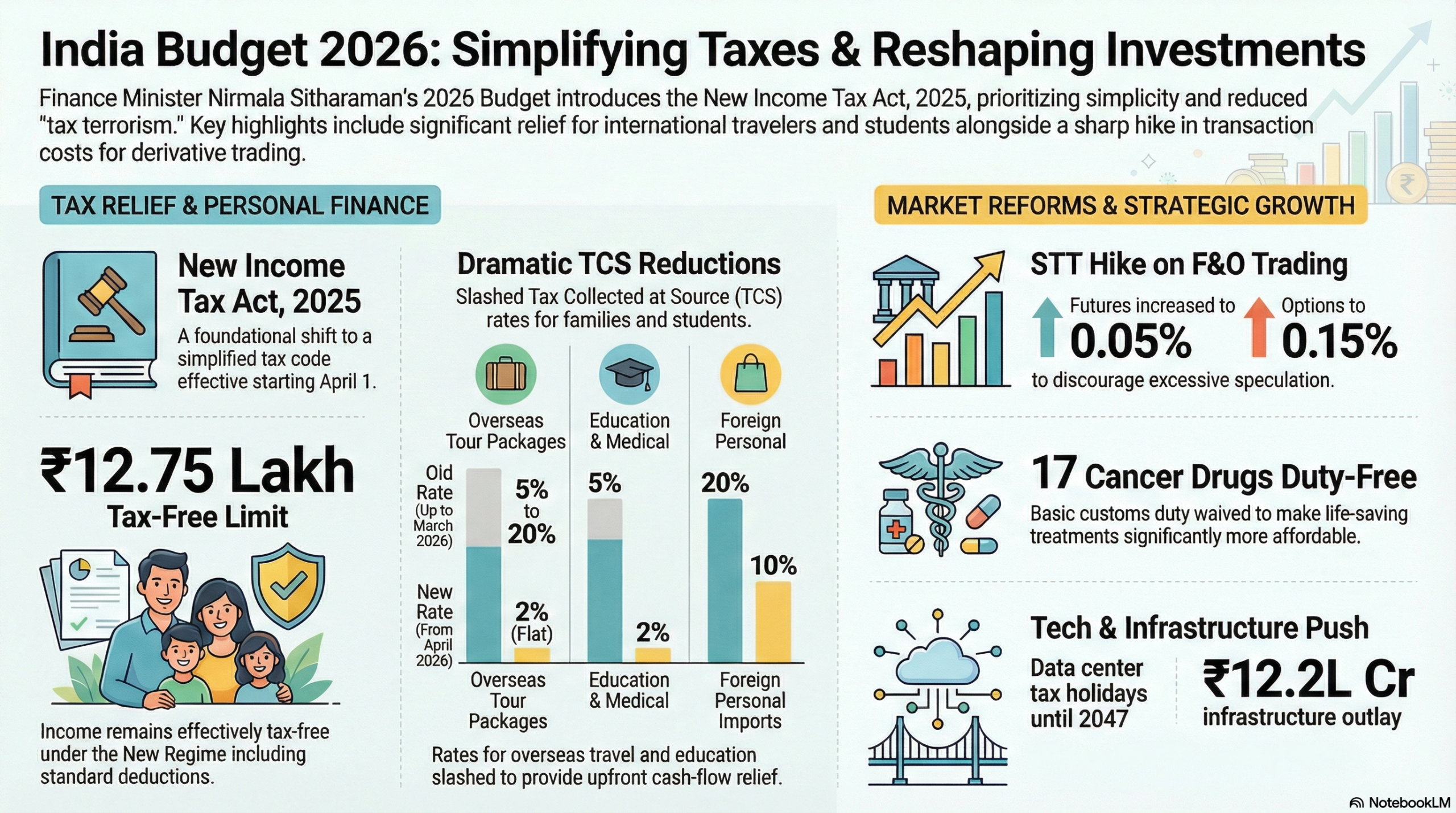
If you are an active trader in India, February 1, 2026, brought a “reality check” to your terminal. Finance Minister Nirmala Sitharaman announced a significant hike in the Securities Transaction Tax (STT) specifically for the derivatives segment, terming it a “course correction” to curb excessive speculation.
Effective April 1, 2026, the cost of doing business in the F&O market is going up—by a lot. At GlobalFinMate India, we’ve calculated exactly how much more you’ll be paying and how to protect your capital.
The New Math: STT Rates (Effective April 1, 2026)
The hike isn’t just a small adjustment; it’s a 150% jump for futures and a 50% jump for options.
| Instrument | Old Rate | New Rate (Budget 2026) | % Increase |
| Equity Futures (Sale) | 0.02% | 0.05% | +150% |
| Equity Options (Premium Sale) | 0.1% | 0.15% | +50% |
| Options Exercised | 0.125% | 0.15% | +20% |
| Intraday Cash / Delivery | Unchanged | Unchanged | 0% |
F&O Survival Guide: The Real-World Impact: Nifty Futures Case Study
Let’s see how this affects a single trade. Assume you sell 1 lot of Nifty Futures at a level of 25,000 (Lot size = 65).
- Contract Value: ₹16,25,000
- Old STT (0.02%): ₹325
- New STT (0.05%): ₹812.50
- Difference: You pay an extra ₹487.50 per lot, every time you sell.
If you are a high-frequency trader doing 10 such trades a day, you are looking at an additional ₹4,875 per day in taxes alone—regardless of whether you made a profit or loss.
Why the Government Did This
The rationale is simple: Risk Management. Recent data suggests that over 91% of retail F&O traders lost money in FY25. By raising the cost, the government aims to:
- Reduce “Satta” (Gambling) Behavior: Discouraging impulsive, high-frequency trades.
- Shift Focus to Cash Market: Encouraging investors to move toward long-term equity delivery, where STT remains low and stable.
- Revenue Generation: The move is expected to generate over ₹73,000 Crore for the exchequer.
Immediate Market Reaction
Markets reacted negatively after the announcement:
- Benchmark indices like Sensex and Nifty fell 1–2%
- F&O-heavy stocks saw selling pressure
- Trading volumes are expected to decline 20–30% in the short term
Industry leaders, including Zerodha founder Nithin Kamath, pointed out that higher STT may also affect genuine hedgers, not just speculators.
Who Is Affected?
- High-frequency and intraday F&O traders
- Small retail traders with limited capital
- Algo traders operating on thin margins
For many traders, overall trading costs could rise 2–3 times, making short term strategies less viable.
Expert View & Long-Term Outlook
Market experts believe the government’s decision is aimed at cleaning up market behaviour rather than restricting participation. By making speculative trading more expensive, the move is expected to reduce unnecessary and impulsive trades.
- Over the long term, this can lead to:
- Better quality participation in the markets
- Lower risk to the overall financial system
- More responsible behaviour from retail investors
Regulators may also introduce additional safeguards, such as tighter position limits or further risk controls, to ensure market stability. The long-term message from Budget 2026 is simple and clear: Less focus on speculation, more focus on real wealth creation. Investors who align with this approach are likely to benefit the most in the years ahead.
Also Read: Union Budget 2026 Highlights: New Tax Act, TCS Relief & STT Hike Explained
Frequently Asked Questions (FAQs)
From when will the new STT rates apply?
The revised STT rates announced in Budget 2026 will come into effect from April 1, 2026. Until then, the existing rates (0.02% for Futures and 0.1% for Options) will continue to apply.
Is the STT hike applicable to buying options as well?
No. In India, Securities Transaction Tax (STT) on options is only charged on the sale of option contracts (premium). However, if you exercise an option, the buyer is liable to pay STT at the new rate of 0.15%.
Does this budget change the tax on long-term stock investing (Delivery)?
Finance Minister Nirmala Sitharaman explicitly stated that the STT on Equity Delivery (buying and holding shares) and Intraday Cash trading remains unchanged. The hike is strictly targeted at the Derivatives (F&O) segment.
Can I claim the STT paid as a deduction in my Income Tax filing?
If you are a Business Trader (treating F&O as business income), you can claim STT as a business expense. However, if you are an Investor (treating it as Capital Gains), you cannot deduct STT from your profits or add it to your losses.
Why did the government increase STT specifically for F&O?
The government and SEBI are concerned about the “Satta” (gambling) nature of retail trading. Data shows over 91% of retail traders lose money in F&O. The hike is a “behavioral tax” designed to discourage excessive speculation and protect small investors’ savings.
Follow us: www.Globalfinmate.com